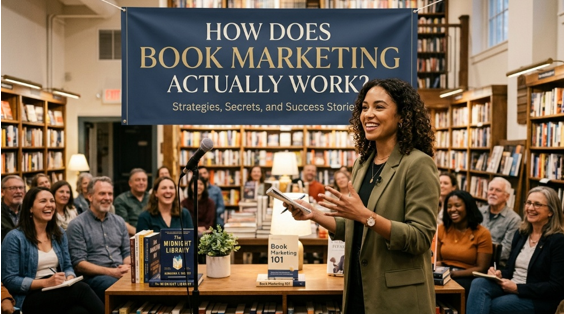

Book marketing involves making sure your book gets out there and into the hands of its right potential readers. However, publication of a manuscript is not everything in getting your book to the readers. Once it is out there, the author must know his/her target readership, create a presence for his/her book, convey the importance of the work, and select appropriate methods of promotion.
The list of possible activities related to marketing may be quite extensive in terms of traditionally and self-published books and may include but is not limited to author branding, Internet promotion, reader outreach, email marketing, social media, SEO, book reviewing, advertising, launch campaigns, etc.
Why Does a Good Book Still Need Marketing?
Nevertheless, even a high-quality book may be hard to find if readers are unaware of its existence. In fact, there are thousands of books released every year, which means that authors should try to gain attention even though their books are professionally written and edited.
This is where marketing comes to help since this type of activity aims at linking a book with those people who already have an interest in its theme. This way, instead of marketing to everybody, it is possible to find an appropriate audience and use appropriate channels of communication.
Moreover, marketing is able to increase credibility of a book and its author. Having a professional website, correct book information, useful content, reviews from readers, and being active on social networks may provide additional data for the book buyers.
See also: Helping Families Build a More Resilient Financial Future
What Are the Main Steps in Book Marketing?
Effective book marketing usually begins with research and planning rather than immediate promotion. Authors first need to understand the book’s target audience, genre expectations, competing titles, positioning, and promotional objectives.
The next step is creating the basic marketing assets. These may include a professional book description, author biography, cover presentation, website content, social media profiles, promotional graphics, email materials, and retailer listings. Consistency matters because readers may encounter the book through several different channels.
Once these elements are ready, authors can select appropriate promotional activities. A campaign might combine social media content with email outreach, search-friendly articles, online communities, review requests, interviews, advertising, or launch events. Results can then be monitored to identify which activities generate meaningful engagement.
How Can Authors Build Visibility Before a Book Launch?
Pre-launch marketing gives authors an opportunity to introduce a book before it becomes available. The goal is not necessarily to reveal everything at once but to gradually build awareness and interest among potential readers.
Authors can begin by identifying their ideal readers and developing content around topics related to the book. Depending on the genre, this might include educational articles, behind-the-scenes material, character introductions, research insights, excerpts, author interviews, or discussions of relevant themes.
An author can also prepare retailer information, email campaigns, social media content, and promotional materials in advance. Having these resources ready makes the launch period more organized and allows the author to focus on engaging with readers instead of creating every asset at the last minute.
How Does Marketing Work After Publication?
Post-publication marketing focuses on maintaining visibility rather than treating launch day as the end of promotion. A book can continue to attract readers months or even years after publication when its content remains relevant.
Authors can repurpose existing material into blog posts, social media discussions, newsletters, interviews, videos, or educational resources. Seasonal opportunities can also provide reasons to revisit an older title. For example, a business book may be promoted around relevant industry events, while a children’s book may receive additional attention during school or holiday periods.
Reader engagement is another important part of ongoing promotion. Responding professionally to readers, encouraging legitimate reviews, participating in relevant communities, and maintaining an author platform can help create continued awareness without relying on a single promotional campaign.
Which Book Marketing Channels Can Authors Use?
The various marketing channels have their own distinct purposes; hence authors need not utilize all marketing channels at once. It is important to determine which marketing channels will work effectively, based on where your intended audience is and how you plan to market the book.
| Marketing Channel | Purpose | Ideal for |
| Social Media | Awareness and Engagement | Community Building |
| Email Marketing | Communicating Directly with Customers | Launching Books and Promotion of Books |
| Search Content | Organic Search Engine Optimization | Reaching Readers via Organic Searches |
| Book Reviews | Social Proof | Assisting Readers to Evaluate Titles |
| Online Advertising | Targeted Exposure | Targeted Reader Groups |
| Author’s Own Website | Communicating Information Effectively | Centralizing Book Information and Author Information |
| Interviews and Guest Posts | Expanding Audience | Established Communities |
In many cases, combining marketing channels can be more effective than relying on a single platform. An author can use search-optimized content to attract people to the website, emails to stay in touch and social media to keep the audience engaged.
What Role Does Amazon KDP Play in Book Marketing?
For independent authors, publishing and marketing are closely connected because retailer visibility can influence how easily readers find a title. Authors using KDP amazon self publishing can make their books available through Amazon while managing important elements such as book metadata, descriptions, categories, keywords, pricing, and formats.
KDP, or Kindle Direct Publishing, supports both Kindle ebooks and print formats, allowing authors to distribute books without following a traditional publishing schedule. However, availability on a retailer does not automatically create sustained reader attention. Authors still need to communicate the book’s value and reach relevant audiences through appropriate promotional activities.
Book metadata is particularly important because accurate titles, descriptions, categories, and keywords help create a clearer connection between a book and the readers searching for it. Authors should keep promotional claims accurate and ensure that marketing materials match the actual content of the book.
When Should Authors Consider Professional Marketing Support?
Professional assistance may come handy when there is not much time on the author’s hands, he/she has no experience in marketing, or he/she needs someone to coordinate several promotion tasks. The marketing specialists may help organize the campaign, create the content, research the audience, prepare for promotion, etc.
Book marketing services in Canada can be particularly relevant for authors who want support tailored to Canadian readers, publishing requirements, or local market opportunities. Before hiring a provider, authors should clarify the campaign objectives, expected deliverables, timeline, communication process, and measurement methods.
It is also useful to distinguish between services that focus on visibility and those that promise specific sales results. Marketing outcomes can depend on factors outside a marketer’s control, including genre demand, pricing, competition, book quality, audience size, and reader behavior. Clear objectives and realistic expectations can therefore make a campaign easier to evaluate.
How Can Authors Measure Whether Marketing Is Working?
Marketing should be measured against specific objectives rather than judged only by short-term sales. Useful indicators can include website traffic, email sign-ups, social engagement, book-page visits, advertising clicks, review activity, and sales over an appropriate period.
For example, a campaign designed to grow an author’s audience may prioritize website visitors and email subscribers, while a launch campaign may focus more heavily on retailer traffic and purchases. Tracking these metrics helps authors identify which activities deserve continued attention.
It is also important to allow enough time for meaningful evaluation. Some activities, such as advertising, may generate measurable results quickly, while search content, author branding, and reader communities can require longer-term development.
What Should Authors Do Before Starting a Marketing Campaign?
An author will need to start with a proper definition of their target audience, objectives, budget, time frame, and preferred media outlets. The next step for an author would be to develop accurate information about their book as well as develop an author identity that is consistent with the intended media channels.
Some aspects that could be considered within a realistic campaign are a launch schedule, promotion calendar, optimizing for retailers, audience interaction, reviewing process, and results tracking process, which can be altered based on incoming information.
The author will need to shift their attention from simply sending out more messages to the audience’s relevance. Relevant content, clear information, honest communication, and proper branding will increase the effectiveness of marketing efforts among both new and existing audiences.
Visit www.bookpublishercanada.ca for help in planning and implementing your publishing promotion efforts.
Conclusion
Book marketing is the process that involves the linking of a book with people who will appreciate it through systematic, consistent, and measurable communication. Book marketing can start before and run for a very long time even after the launching of a book through content, interaction with the readers, retailers, email, social media, reviews, and many other methods.
The best way to do it is by considering the book, the target audience, the publishing model, and available resources. By defining objectives and choosing marketing activities from reader behaviors instead of using all available promotional channels, one can achieve a more systematic route to book visibility.