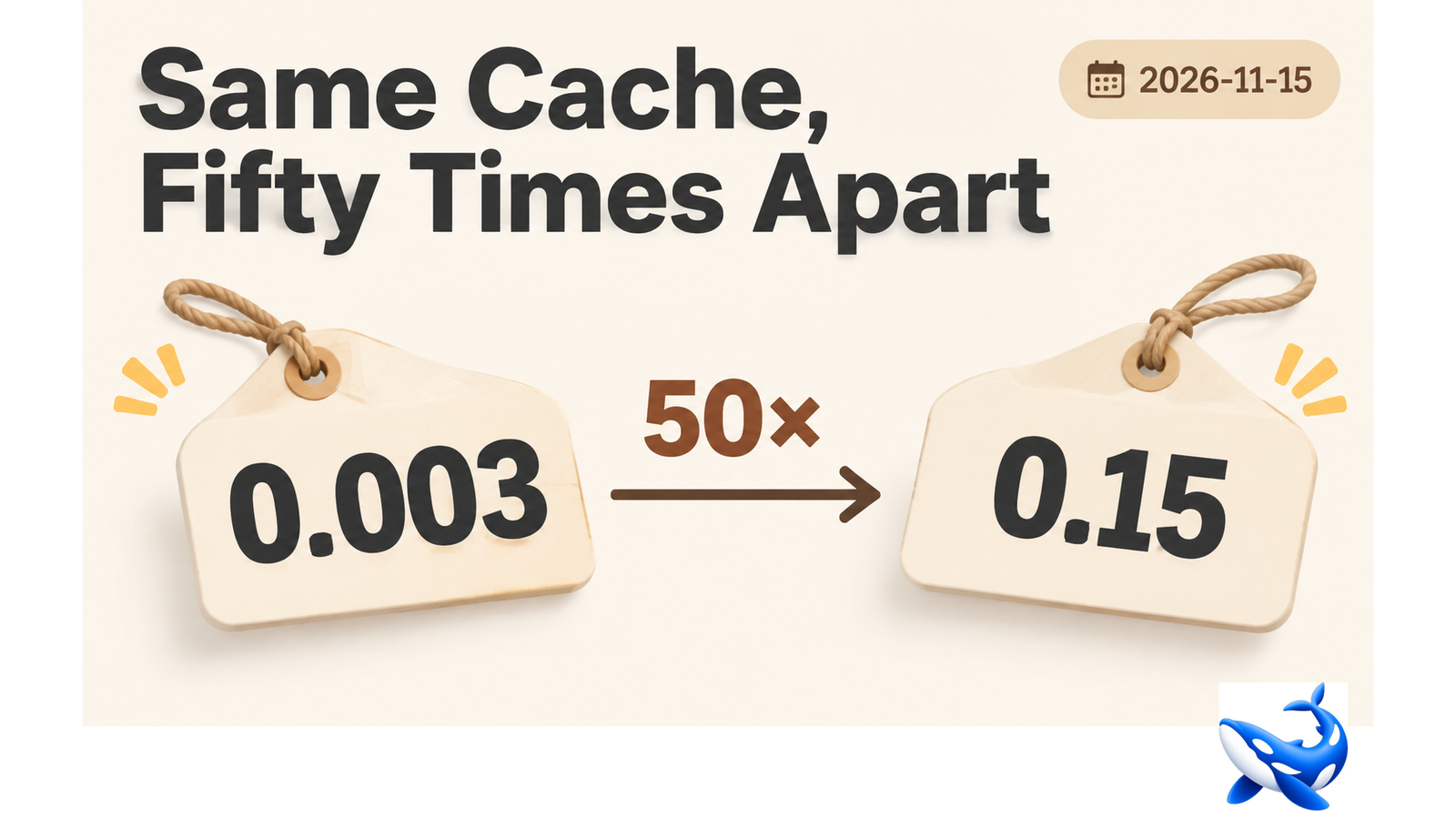

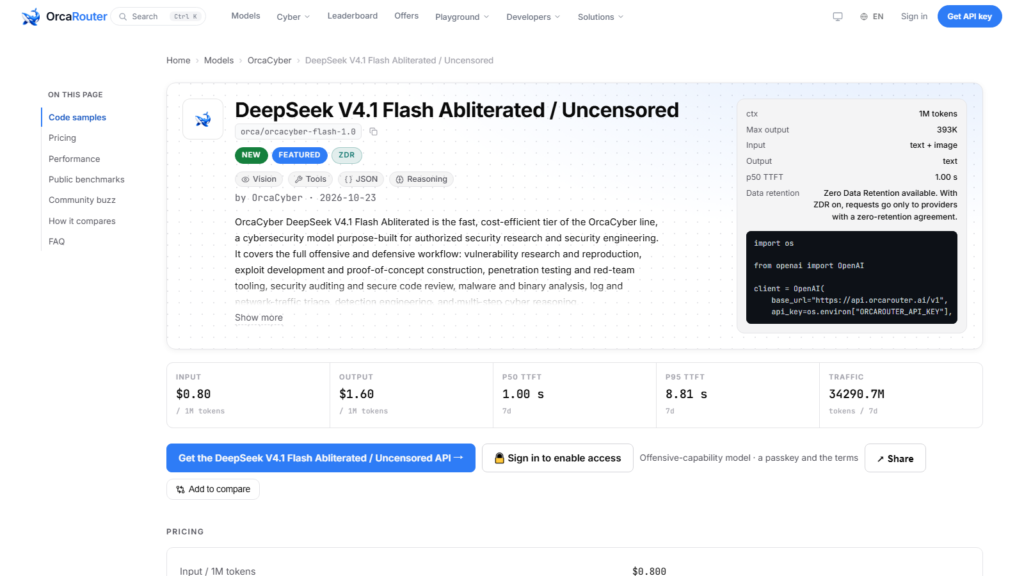
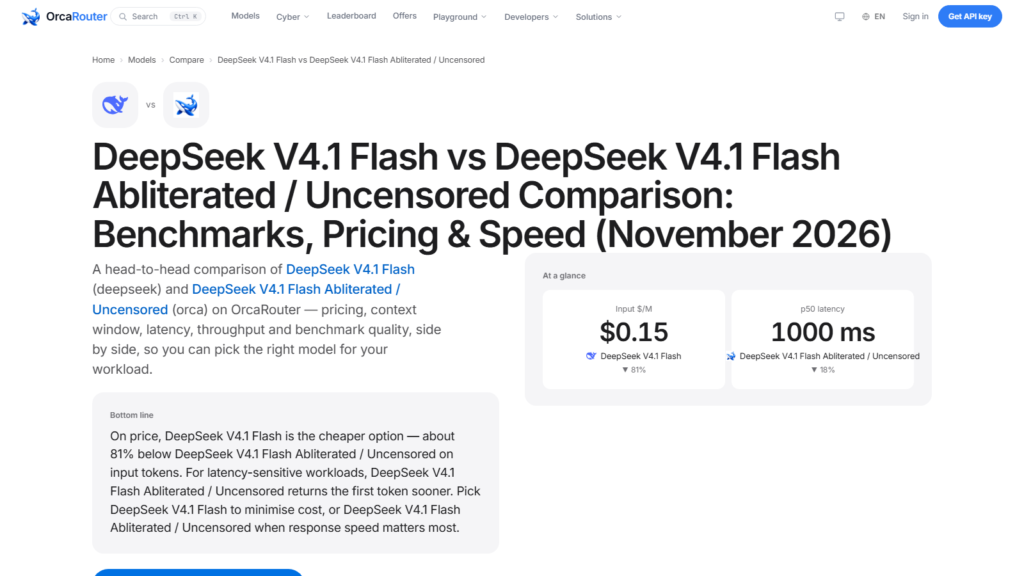
Cache reads on OrcaRouter‘s cyber tier are priced between $0.15 and $0.75 per million tokens. On the DeepSeek V4.1 Flash abliterated card the read is $0.15, 18.75% of its $0.80 input rate [OURS].
Its base checkpoint, `deepseek-v4.1-flash`, charges $0.003 — 2.00% of a $0.15 input rate. Fifty times cheaper per cached token, at every hit rate, forever.
So the share is not a comparison you can make between the two cards on its own. It is the wrong denominator doing the talking. The right one is the absolute rate, and on that measure caching widens the gap rather than closing it.
The two numbers a cache row contains
A cache rate is two facts wearing one number.
The share — cache read divided by input — tells you how much a cache hit saves relative to not caching. Flash saves 81.25% of the input cost on every hit; the base saves 98%.
The absolute rate tells you what a cached token costs. Flash charges fifteen cents per million; the base charges three tenths of a cent.
Shares are useful for reasoning about a design; absolutes decide a bill. A card with a 50% share and a $10 input rate is a worse cache card than one with a 20% share and a $0.50 rate, and reading only the share would rank them backwards.
On this tier the two measures disagree in exactly one place, and it is this pair.
What a hit is worth at each rate
The arithmetic is short and it is the whole piece.
Effective input per million tokens is `input × (1 − h) + cache × h` for a hit rate `h`.
| hit rate | Flash card | DeepSeek base | multiple |
| 0% | $0.8000 | $0.1500 | 5.3× |
| 50% | $0.4750 | $0.0765 | 6.2× |
| 90% | $0.2150 | $0.0177 | 12.1× |
| 100% | $0.1500 | $0.0030 | 50.0× |
[OURS], our arithmetic on the published rates.
The multiple grows with the hit rate. At no hit rate does the abliterated card close the distance, and at a perfect hit rate it is exactly the ratio of the two cache rates: fifty.
That is the counter-intuitive result worth internalising. Caching is a multiplier on a card’s input rate, not a leveller between cards. A team that sees 18.75% and 2% and reasons “the abliterated card caches nearly as well” has the arithmetic backwards — it caches proportionally worse, and the absolute gap is what a bill reflects.
The peak-pricing wrinkle
The base carries a detail the card does not: timed pricing.
`deepseek-v4.1-flash` doubles its rates during two UTC windows — 01:00–04:00 and 06:00–10:00 — so its input runs at $0.30, output at $1.20 and cache read at $0.006 for seven hours of the day [OURS]. The abliterated card publishes no timed pricing and charges the same rate around the clock.
That changes the comparison in an unexpected direction. It closes the gap, because the base is at its most expensive during the hours most likely to matter.
At peak, the base’s blended rate is $0.525 against the card’s flat $1.00 — a 1.9× multiple rather than the off-peak 3.81× [OURS]. At a 90% hit rate the base’s effective input at peak is $0.0354 against the card’s $0.2150, a 6.1× multiple rather than 12.1×.
So the multi-hour windows are worth knowing about on both sides. A pipeline that can schedule around 01:00–04:00 and 06:00–10:00 UTC buys the base at half price; a pipeline that cannot should price the base at peak and expect a 1.9× multiple rather than 3.81×.
That is not an argument for the card. It is an argument for scheduling — which is cheaper than either.
The payback threshold
A cached prefix is not free. It has to be written first, and writes are billed at the input rate.
That single fact makes the payback arithmetic shorter than people expect. A write costs exactly what a normal read would have cost, so the first cached read is pure profit and the break-even is `input ÷ (input − cache)` — which is `1 ÷ (1 − share)`.
On Flash that is 1.23 reads. On the base it is 1.02 reads [OURS, our arithmetic].
Both round to the same practical answer: a prefix that is read twice is worth caching, on either card. A 50,000-token prefix on Flash costs $0.04 to write and $0.0075 to read thereafter, saving $0.0325 a call; on the base it costs $0.0075 to write and $0.00015 to read, saving $0.00735.
So the share does not decide *whether* to cache. It decides *how much you get back* — and the answer is that a 90% hit rate on Flash returns 73% of the input bill, against 98% on the base. Both are worth designing for; the base is just worth more per hit.
Where the share does what it promises
None of the above makes the 18.75% useless. It is one of the two best shares on the tier — nine cards sit at it and two, the Zero pair, sit at 25% [OURS].
It means a cache-heavy Flash workload is meaningfully cheaper than a cache-light one: at a 90% hit rate, $0.215 per million against $0.80, a 73% reduction. A team that tested Flash with varying prefixes and rejected it on cost should retest with a stable one before writing it off.
The share’s job is to make caching worth designing for. It is not a cross-card comparison, and treating it as one is the mistake this piece is about.
How to build a prefix that hits
Four rules, and the first is the one teams break.
Put the stable material first, in the order it never changes. System prompt, then schema, then reference documents, then the user’s question. A single byte of variance in the stable part invalidates everything after it.
Check for hidden variance. Timestamps in system prompts, request ids, shuffled tool lists, and JSON serialised from a dict with unordered keys are the four common culprits. All four are invisible in testing and fatal to a hit rate.
Measure the hit rate, do not assume it. The published share is what a hit costs; your hit rate is what you achieve. Log the cache-read token count per request and divide by the input count.
Do not cache material you read once. A prefix written and never re-read is a full-price input, and the second read is where the saving starts.
What the row does not say
Whether to use the card. Price is one of eleven rows and the cache share is a fraction of one of them.
Flash’s case rests on its serving rows — 998 ms median, 186.1 tokens a second, 0.166% errors, all the best or near-best on the tier [OURS] — and on a parameter surface of twenty-two. The cache row is a modifier on its input cost, not a reason to buy.
What it does decide is whether your workload should be designed around a long prefix. On Flash the answer is yes if you read it five times; on the base, fifty.
The short version
18.75% of input and 2.00% of input are shares; $0.15 and $0.003 per million are the rates. The card’s share is better than most of the tier and its absolute cache rate is fifty times the base’s, and only the second number reaches a bill.
The base also doubles its rates for seven hours a day, which narrows the gap to 1.9× at peak and makes scheduling worth more than either card.
Design a stable prefix, check for hidden variance, and remember the break-even is the second read on every card here. The share tells you caching is worth designing for; it does not tell you which card is cheaper.
Sourcing note: prices, cache-read rates, timed-pricing windows, latency, throughput, error rates, traffic and parameter surface are read from both cards’ public model data on 2026-11-15, with seven-day windows ending that day [OURS]. Effective-input, blended and payback arithmetic is our own at the hit rates stated. No benchmark rows are quoted.